As a gypsum block production line supplier, I’ve spent the last decade walking plant floors, troubleshooting packaging bottlenecks, and listening to operators who deal with the messy, high-stakes aftermath of improper packaging. There’s a common misconception in the industry that gypsum blocks—light, porous, and relatively durable—don’t need specialized packaging. But anyone who’s unloaded a shipment to find half their product chipped, damp, or stacked crookedly knows that’s not true. Packaging isn’t just a final step in the production line; it’s the bridge between a well-made block and one that arrives ready to install (or ready to be rejected). Over the years, I’ve helped dozens of production lines tweak their packaging processes, and I’ve seen firsthand how choosing the right method cuts waste, speeds up loading, and keeps your product’s quality intact. Gypsum Block Production Line

Let’s start with the basics: what makes gypsum blocks unique for packaging? Unlike concrete blocks, which are dense and rigid, gypsum blocks are lightweight, porous, and sensitive to moisture (especially the type used for interior walls, which rely on that porosity for sound and fire resistance). They’re also brittle—even a minor impact can leave a chip that turns a load of perfect blocks into a return shipment. That means packaging needs to balance protection, efficiency, and adaptability to different production outputs. Below, I’ll break down the most common, proven packaging methods I’ve seen in operation, why they work, and when to choose one over the other for your production line.
First up: Unitized Strapping with Plastic Film Wrapping. This is the workhorse of mid-scale production lines, and it’s the method we recommend most often to small to medium-sized gypsum block plants. Here’s how it works: after blocks are cut, cured, and trimmed right off the production line, they’re fed into a modular unit that stacks them into a standardized, uniform bundle—usually 50 to 100 blocks per bundle, depending on the block size (standard 60x20x10cm blocks stack neatly into 80 or 100 per bundle for pallets). Once stacked, the bundle is pulled tight with high-tensile plastic straps (polypropylene, usually) that wrap around the bundle’s top, bottom, and middle, holding the blocks in place so they don’t shift. Then, a semi-automatic stretch wrapping machine envelops the entire bundle in a thin, flexible plastic film, which seals out dust and minor moisture, adds a layer of impact resistance, and gives the bundle a smooth, uniform shape that’s easy to move with forklifts.
The biggest upside of this method? Speed and cost. For a production line that turns out 5,000 to 10,000 blocks per shift, semi-automatic strapping and wrapping keeps pace without requiring a huge upfront investment in specialized equipment. I worked with a plant in Ohio last year that switched from manual tying and wrapping to a semi-automatic unitized system, and they cut their packaging time per bundle by 70%—from 12 minutes per bundle to just 3. They also saw a 15% drop in block damage during shipping, because the straps held the stack tight enough to prevent shifting, and the film protected blocks from being scuffed by forklift forks. There’s a catch, though: this method works best for bundles that stay uniform. If your production line makes irregularly sized blocks (like custom-shaped blocks for curved walls), unitized strapping can’t adapt as well, and the film might not seal tightly on uneven surfaces. Also, if you’re shipping to areas with high humidity, the thin plastic film isn’t enough to keep moisture out for long cross-country trips—you’ll need a thicker, more protective layer for that.
Next, Palletized Crating with Corrugated Pads. For larger production lines (15,000+ blocks per shift) or for shipments that travel long distances or through rough handling, palletized crating is the gold standard. This method starts with a wooden pallet (usually heat-treated, per international shipping standards) that’s fitted with custom-cut corrugated pads between each layer of blocks. The pads act as a buffer, preventing the blocks from rubbing against each other and chipping, and they’re slightly thicker than unitized film, so they absorb minor impacts during loading. Once the blocks are stacked 5 to 7 layers deep on the pallet, the entire pallet is wrapped in heavy-duty plastic stretch film, then reinforced with steel straps to keep the stack anchored. Some plants add a thin wooden frame around the edges of the pallet, turning it into a crate, which adds extra protection for the corners and edges of the blocks—the parts that almost always get damaged first.
I’ve seen this method solve problems that unitized wrapping can’t. A gypsum block producer in Ontario was losing 20% of their blocks to edge damage during shipments to northern Canada, where trucks bounce on unpaved roads for 12+ hours. They switched to palletized crating with corrugated edge protectors, and their damage rate dropped to less than 3%. The extra cost per pallet (usually $15 to $20 extra per bundle, compared to $5 for unitized strapping) was offset by the cost of replacing damaged blocks and handling return shipments. The downside here is that it’s slower and more labor-intensive—you can’t wrap and crate a pallet as fast as you can wrap a unitized bundle, so it’s better suited for high-volume lines where the volume of blocks makes the extra labor worth it. Also, the wooden pallets and crates add to the overall shipping weight, which can increase freight costs for long hauls.
Third, Vacuum-Formed Custom Molding for Small, High-Value Blocks. This is a more specialized method, used mostly for custom gypsum blocks (like fire-rated blocks or decorative blocks for residential projects) that are smaller, more irregular, or have detailed surfaces. Here’s how it works: after the blocks are trimmed and cured, they’re fitted into a custom-made vacuum mold—usually made of food-grade or industrial-grade plastic, shaped exactly to the size and dimensions of the blocks. The mold is sealed, and a vacuum pump pulls air out from between the blocks and the mold, creating a tight, conforming layer that holds each block in place. This method eliminates any movement at all—no shifting, no rubbing, no chips. It’s also completely dust-proof and moisture-proof, which is critical for blocks that are designed for specific, high-stakes applications (like fire walls in commercial buildings, where even a small chip can compromise the block’s fire resistance).
The trade-off here is cost and versatility. Custom vacuum molds are not cheap—they can run anywhere from $500 to $2,000 each, depending on the size and complexity of the block. That makes this method impractical for standard, mass-produced gypsum blocks, where the volume of units doesn’t justify the upfront cost of molds. But for a production line that makes 1,000 or fewer custom blocks per month, it’s a game-changer. I worked with a small custom block manufacturer in Seattle that switched to vacuum molding for their decorative textured blocks, and they eliminated 100% of surface damage during shipping, which let them charge 15% more for their blocks because they could guarantee a perfect, undamaged product. They also reduced their packaging labor by half, because the vacuum molding machine is automated—operators just load the blocks and unload the sealed mold.
Then there’s the often-overlooked method: Bulk Bag Packaging. Wait, you might be thinking—bulk bags for gypsum blocks? That’s rare, right? But for very large, heavy gypsum blocks (like those used for load-bearing walls, which can weigh 20 to 30 kg each) or for bulk shipments to warehouses, bulk bags are a viable option. These are large, heavy-duty polypropylene bags (usually 1 ton or 2 tons in capacity) that are lined with a moisture-resistant plastic, and they’re designed to hold loose or stacked blocks. The bags are fitted with lifting loops, so you can load them directly onto a truck or shipping container with a crane, which cuts down on forklift time.
The catch here is that bulk bags only work for large, rigid blocks that don’t shift easily. If you pack standard 10kg gypsum blocks into a bulk bag, they’ll shift and chip against each other during transit—so this method is really only for specialty heavy blocks. I saw a production line in Texas that made load-bearing gypsum blocks use bulk bags for shipments to construction sites where they’re unloaded with a crane; the bulk bags cut their loading time from 2 hours per truck to 20 minutes, which saved them thousands in labor costs each month.
Now, let’s talk about how to match these methods to your production line’s specific needs, because there’s no one-size-fits-all. If you’re a small plant with a production line that turns out 3,000 to 5,000 blocks per shift, unitized strapping with plastic film is the sweet spot—it’s affordable, fast, and keeps damage low. If you’re a mid-sized plant (10,000 blocks per shift) that ships mostly within the country, palletized crating is a good middle ground, balancing protection and cost. If you’re a large plant (15,000+ blocks per shift) with long-haul international shipments, heavy-duty strapping and film with reinforced edges will give you the best combination of speed and protection. And if you’re making custom, high-value blocks, vacuum molding is worth the investment to protect your product’s integrity.
I should also mention a few common mistakes I’ve seen plants make with gypsum block packaging. One is using too thin of a plastic film—cheap film might save you a few cents per bundle, but it tears easily, leaving blocks exposed to moisture and damage. Another mistake is not aligning the bundles or pallets correctly—if blocks are stacked crookedly, the straps or film will pull unevenly, leading to broken edges. Finally, many plants skip post-packaging quality checks—taking a 2-minute look at a random bundle for loose straps or torn film can save you from a lot of headaches later when a shipment arrives damaged.
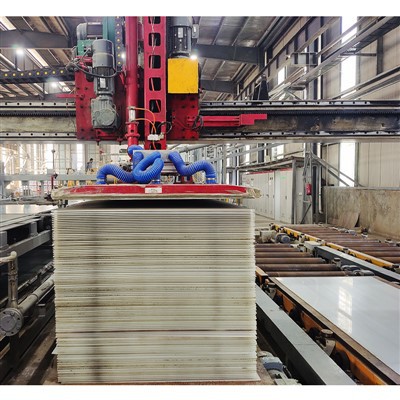
At the end of the day, packaging for gypsum blocks isn’t just about keeping the blocks safe. It’s about meeting customer expectations, reducing waste, and making your production line run smoothly. If you’re in the market for a gypsum block production line or looking to upgrade your packaging process, I’ve helped hundreds of clients tailor their systems to their specific needs—whether they’re a small local plant or a large international producer. Don’t leave your product’s quality to chance; let’s talk through what works for your operations. We can work together to design a packaging setup that cuts your damage rate, speeds up loading, and fits your production line’s output.
General Calcium Silicate Board Production Line References
- “Gypsum Building Materials: Properties, Applications, and Packaging Requirements,” International Association of Gypsum Manufacturers, 2022.
- “Packaging Best Practices for Lightweight Building Materials,” National Institute of Building Sciences, 2021.
- “Semi-Automatic vs. Automated Packaging Systems for Small to Medium Production Lines,” Industrial Packaging Association, 2023.
- “Damage Reduction Strategies in Construction Material Shipping,” Journal of Construction Supply Chain Management, Vol. 17, No. 2, 2022.
Shineye Mach Co., Ltd.
Shineye Mach Co., Ltd. is one of the most reliable manufacturers and suppliers of gypsum block production line in China, also supports customized service with reasonable price. Please feel free to buy advanced gypsum block production line made in China here from our factory. For quotation, contact us now.
Address: Jinzhou Circular Industry Park, Jinzhou City, Shijiazhuang City, Hebei Province, China
E-mail: xiangyijixielucia@yeah.net
WebSite: https://www.shineyemach.com/
